Laterals, roots & trenchless repair
Sewer Line Repair in Lancaster, PA
If your basement floor drain backs up every few months, the problem is probably the sewer lateral running under your yard or sidewalk. Here’s how plumbers find out what’s wrong and the options for fixing it in Lancaster.
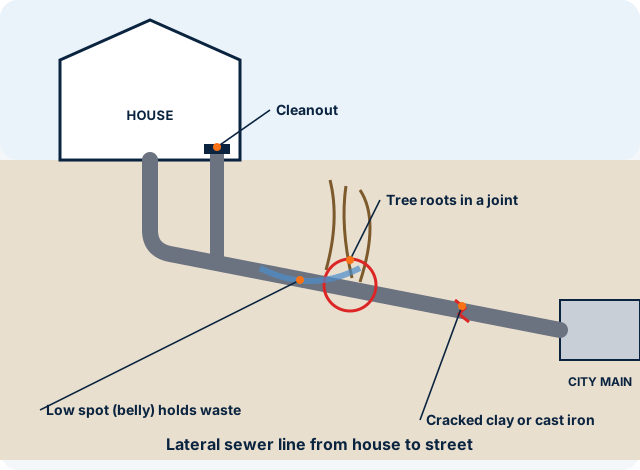
What Your Sewer Lateral Is
Sewer line repair in Lancaster usually means repairing or replacing the lateral, the private pipe that carries everything from your house to the public sewer main under the street. It’s typically the homeowner’s responsibility, and in older neighborhoods it’s often clay, cast iron or Orangeburg pipe that’s been in the ground for 60 to 100 years.
Where your responsibility ends depends on the municipality. In some places it’s the property line or curb; in others it’s the connection at the main itself. Lancaster City, the surrounding townships and the boroughs each have their own sewer authority and rules, so it’s worth a call to yours. A plumber can show you exactly where the problem is with a camera, which settles most questions about who pays. For problems inside the house, start with drain cleaning; for everything plumbing, a plumber in Lancaster, PA.
Old Sewer Pipe Around Lancaster
| Pipe material | Where you see it | How it fails |
|---|---|---|
| Vitrified clay | City rowhomes and pre-war houses | Short sections with many joints; roots get in, joints shift, pieces crack |
| Cast iron | Under basement floors and out to the curb in older homes | Rusts from the inside, scales up, cracks and rots along the bottom |
| Orangeburg (bituminous fiber) | Many homes built roughly 1945 to 1970 | Softens, blisters and flattens into an oval, then collapses |
| PVC | Newer homes and replaced laterals | Durable; problems are usually poor installation or a belly |
Lancaster’s tree-lined streets are part of its charm, but maples and sycamores send roots toward the moisture leaking from old clay joints. Once inside, roots grow into a net that catches paper and waste. Cleaning clears them for a while; they always grow back until the joint is sealed.
Signs of a Sewer Line Problem
- The basement floor drain backs up, especially when the washer drains or someone showers.
- Several drains are slow at once, or the toilet gurgles when the tub drains.
- Sewage smell in the basement or yard.
- Recurring clogs that come back weeks or months after being snaked.
- Wet, sunken or unusually green patches of lawn along the path of the line.
- Cracks in the basement floor near where the drain exits, in severe cases.
Camera Inspection Comes First
Before anyone talks about digging, a plumber should run a waterproof camera through the line from a cleanout. It shows roots, cracks, offset joints, bellies and collapses, and a locator on the camera head pinpoints the depth and location from the surface. Ask for the video; it’s yours, and it’s useful for a second opinion or a home sale.
A sewer camera inspection before closing is one of the best inspections you can buy. Standard home inspections don’t include it, and a failed lateral is an expensive surprise.
Repair Options: Dig or Trenchless
| Method | How it works | Good for |
|---|---|---|
| Spot repair | Dig at one location and replace a short section | A single break or root intrusion in otherwise good pipe |
| Full excavation and replacement | Open a trench and lay new PVC | Collapsed lines, bad slope, Orangeburg, or when the yard is already torn up |
| Trenchless lining (CIPP) | A resin-soaked liner is pulled in and cured to form a pipe inside the old pipe | Cracked or root-damaged pipe that still holds its shape; under sidewalks, driveways and landscaping |
| Pipe bursting | A bursting head pulls new pipe through, breaking the old pipe outward | Replacing a full run with minimal digging at each end |
Every dig in Pennsylvania starts with a call to PA One Call (811) at least three business days ahead, so buried gas, electric and water lines are marked. Most sewer work also needs a permit from the municipality or sewer authority, and work in the street or sidewalk may need extra approval. A good contractor handles those for you.
On a Septic System Instead?
Plenty of homes in the county aren’t on public sewer at all. If you have a septic tank, backups can come from a full tank, a clogged outlet baffle or filter, or a failing drain field, as well as from the pipe between the house and the tank. Pumping the tank every few years, keeping wipes and grease out, and not parking on the drain field go a long way. Plumbers handle the house plumbing and the line to the tank; septic contractors handle pumping and drain fields.
Whether you’re on city sewer or septic, recurring backups rarely fix themselves. If water also shows up where it shouldn’t on the supply side, see leak detection, and if sewage is coming up right now, follow the emergency checklist.
Preventing Backups: Cleanouts and Backwater Valves
Two small upgrades make sewer problems easier to handle. The first is an accessible cleanout, a capped opening in the line near the house. Many older homes either don’t have one or have one buried under a finished floor, which forces plumbers to pull a toilet to reach the main line. Adding an outside cleanout makes every future cleaning faster and cheaper.
The second is a backwater valve, a one-way flap that lets waste out but closes if sewage tries to flow back in from the street during heavy rain. Whether one is required or allowed depends on your municipality. If your basement has backed up during storms even when your own line was clear, ask a plumber whether a backwater valve makes sense. For problems with water on the supply side instead, see frozen and burst pipes.
What Affects the Cost of Sewer Work
Sewer repair costs vary more than almost any other plumbing job. Depth matters: a lateral four feet down is far easier than one eight feet under a driveway. So does length, pipe material, and whether the work crosses a sidewalk, street or tree roots. Trenchless methods often cost more per foot but save on restoring concrete, pavers and landscaping. Permits, PA One Call locates and inspections add a little. The best way to compare quotes is to make sure every contractor is quoting the same scope from the same camera footage.
FAQ
Sewer Line Questions from Lancaster Homeowners
Who pays for sewer line repair in Lancaster?
Usually the homeowner pays for the private lateral, from the house to a point set by the local sewer authority, often the property line, curb or the main connection. Rules differ between Lancaster City and surrounding townships and boroughs, so check with yours.
How do I know if roots are in my sewer line?
Recurring slow drains and floor drain backups, especially in an older home with big trees nearby, are classic signs. A camera inspection confirms it.
Does homeowners insurance cover sewer line repair?
Standard policies often exclude wear, tear and root damage to sewer lines. Some insurers offer service line or sewer backup endorsements. Check your policy before you need it.
Is trenchless sewer repair worth it?
When the pipe is cracked but still holds its shape, lining can save you from tearing up a driveway, sidewalk or landscaping. It isn’t suitable for fully collapsed pipe or lines with a bad sag.
How long does an old clay sewer pipe last?
Clay itself lasts a very long time, but its joints don’t. After decades, joints shift and let roots in. Many Lancaster laterals are 80 or more years old.
What is Orangeburg pipe?
A fiber pipe made of wood pulp and tar, used widely from the mid-1940s to around 1970. It deforms and collapses with age and is usually replaced rather than repaired.
Can I get a copy of the sewer camera video?
You should be able to. Ask before the inspection starts. The video shows the condition and location of problems, helps when comparing repair quotes, and can be useful if you’re selling the home or filing an insurance claim.
How long does sewer line replacement take?
Many residential lateral repairs are finished in one to two days once permits and PA One Call locates are done. Trenchless lining is often faster. Longer runs, deep lines or work in the street can take longer.
Will my lawn or sidewalk be torn up?
It depends on the method. Spot repairs and full replacements need a trench, while lining and pipe bursting usually need only small access pits. Ask each contractor how they’ll restore the yard, sidewalk or driveway, and whether that’s included in the price.
Talk to a local Lancaster plumber
Sewer backing up again? Find out what’s really wrong.
One free call connects you with an independent plumbing company that inspects and repairs sewer lines in Lancaster County.
(717) 750-0501